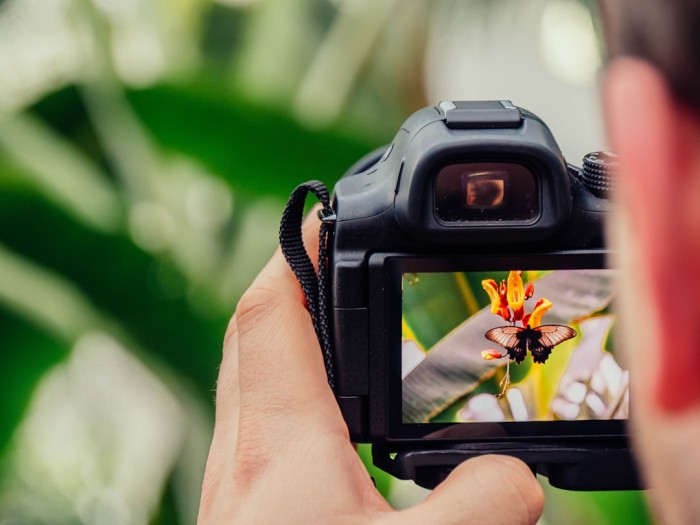
However, the largest or most technically advanced camera isn't automatically the best choice for the outdoors. During a long hike, portability matters too. The most practical camera is therefore one that combines sufficient reach, quick operation, and a size that ensures you’ll actually take it along.
Start with the subject you photograph most often
Nature photography is a broad term. For landscapes, you often want to capture a wide view of the surroundings. With birds and other animals, it’s all about distance: you want to get a close-up shot of the subject without having to walk right up to it. That requires a different lens or a camera with a substantial zoom range.
Flowers, insects, and mushrooms present different requirements. In those cases, what matters most is how close you can focus and how much control you have over which part of the subject remains sharp. Knowing the type of photos you usually take allows you to look for a camera much more selectively.
If you photograph a variety of subjects during a single hike, a versatile setup is often more practical than gear chosen for one specific situation.
For wildlife, reach is often more important than extra megapixels
You usually can't get within a few meters of a bird or a deer. Nor should you try; wild animals need plenty of space. A longer focal length helps you capture the subject in a large, detailed frame despite the distance.
You can achieve this with a mirrorless camera and a telephoto lens, but there are also compact and bridge cameras with extensive zoom ranges. The advantage of the latter is that you don't have to change lenses. A mirrorless camera, on the other hand, offers more freedom to use different lenses later on.
So, if you’re looking to order a new camera for nature hikes, don't focus solely on resolution. Cameranu offers a range of cameras, including compact, mirrorless, and DSLR models. The right choice depends largely on the zoom range you need and how much gear you want to carry with you.
Low light makes using a fast shutter speed more challenging
Even in the middle of the day, a forest can be surprisingly dark. Light levels are even lower early in the morning and around sunset—precisely when many animals are active and the landscape looks most atmospheric.
For a still landscape, you can use a slower shutter speed, especially if the camera is mounted on a stable support. This approach is less effective with moving animals; a bird turning its head or a walking deer might end up blurred. You need a faster shutter speed and must compensate for the lack of light by using, for example, a wider aperture or a higher ISO setting.
In practice, autofocus capabilities, high-ISO performance, and the available lenses are often more important than a slight difference in megapixel count. Image stabilization can help counteract camera shake, but it won't freeze the movement of the animal itself.
You really notice the weight after walking for a few hours
A camera bag might feel fine when you set off, but after a long hike, the combined weight of the camera, telephoto lens, spare battery, and other gear really adds up. This makes weight a practical factor in your decision, rather than a detail to discover only after you’ve made the purchase.
A compact camera is a great option if you want a single device without the need for interchangeable lenses. A mirrorless camera offers more flexibility to tailor your gear to the subject, though a large telephoto lens can still make the overall kit heavy.
So, consider how far you usually walk and what else is already in your backpack. For a short walk starting from the parking lot, you can carry more gear than for a day-long hike that also requires food, drinks, and rain gear.
A fast camera only helps if you can operate it quickly
An animal won't wait while you navigate through a menu. Therefore, make sure you can adjust key settings without having to think twice. For instance, practice changing the shutter speed, focus point, and ISO before planning a special outing.
You can easily do this close to home. Try tracking a moving bird in a park, take photos in a dark patch of woods, and check at home which shots turned out sharp. This also helps you discover where your current equipment actually falls short. You might not need a different camera, but rather more reach or a faster autofocus system.
Also, consider what the camera will be exposed to outdoors.
Out in nature, you won't always encounter ideal conditions. A light rain shower, sand, mud, or condensation might be part of the day. Check the level of protection your camera and lens offer, and if necessary, use a simple rain cover or a bag where you can quickly stow your gear.
Also, bring at least one fully charged battery and sufficient storage space if you’ll be out for a long time. Cold weather can drain batteries faster, while shooting continuous bursts of birds or other moving animals fills up a memory card much more quickly than a leisurely landscape walk.
Ultimately, the best nature camera isn't the one with the longest list of specifications. It is the camera that allows you to effectively capture the subject you are looking for, and is light and practical enough to actually take with you into the forest, field, or nature reserve.